

Hypha Studios x recessed.space: Ground Collective communicate with silent rivers
The second exhibition in the Hypha Studios x recessed.space gallery within the iconic No.1 Poultry is presented by Ground Collective. Formed of nine artists with one guest, the collective have communicated with the long-buried River Walbrook to discover other ways to read & recognise the city. In doing so, they discover other histories & stories, all intermingling through found objects, materials & processes in a beguiling exploration of landscape.
There are many things at Bank junction; for instance: a political
building, a financial building, a trade building, three art galleries, a church
T.S. Eliot wrote about, a war memorial, and many other things as well. A
great number, if not the majority, of these things have been described,
inventoried, photographed, talked about, or registered.
When in 1974 from the Tabac Sait-Sulpice in Paris George Perec set about observing and recording everyday life in the city, he perhaps didn’t know that the resultant text, Tentative’épuisement d'un lieu parisien– or, in English, An Attempt at Exhausting a Place in Paris – would still be pointed at as a canonical way to read everything that can be observed in the city. Setting about to document the ordinary, the ebbs and flows of everyday life that get overlooked while attention is drawn to the unexpected, dramatic, or gestural, he failed in his task. While recording much of what is visible through simply pausing and observing, a political act in any capitalised city, the narrowing and narrowing of attention towards more granular, fragmental moments of the situation revealed that the more you look, the more there is, and that the city is fractal in its formation even if most of us are caught up more in the general flow than the minutiae of its liquid dynamics.
![]()
![]()
![]()
Something Perec succeeded at, however, is the function of the poetic and linguistic as a tool to truly analyse and see in different ways. To remind that art has an ability to not only notice but prioritise and privilege the unnoticed. In one of the three galleries addressing Bank Junction, cocooned at the ground level of James Stirling’s No.1 Poultry, are a collective of artists taking Perec’s treatise to heart, but going deeper.
Perec stopped at the surface, at what was visible to his eye as over the course of two October days as he flitted between café, bench, and tabac. He observes two priests in berets, an apple-green 2CV, three parked mopeds, many baguettes… In fact, his observations are not limited to Parisian clichés, he also notices a Russian astrakhan fur hat, children with dogs, pigeons, an orange cement mixer. Sometimes, he notices things more ethereal such as “lots of people, lots of shadows”, “a light in a building”, “the wind is making the leaves on the tree move”. But, he cannot go deeper, constrained by what is in line of sight. The artists, Ground Collective, can.
![]()
![]()
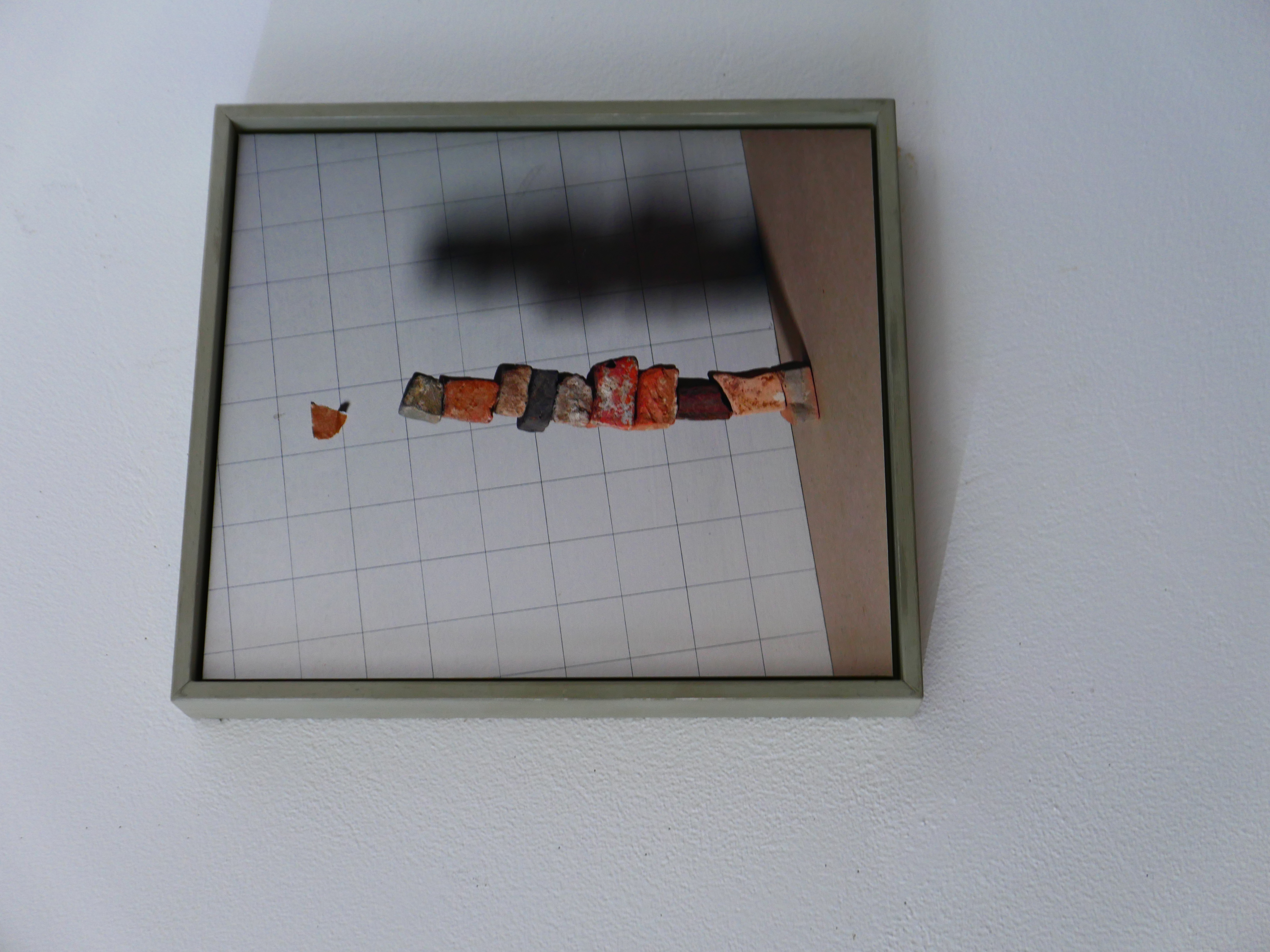
On shelves, behind what was once a café servery, a rhythm of stones sit like punctuation from an unlived sentence. These objects have been extracted from water and history, plucked by Mark Sowden from the Thames foreshow where they had sat for centuries. Before that, they had been artfully arranged as the mosaic floors of Roman villas, but as time changes so does meaning and existence. Sowden has not just placed them in the space, but also his studio, piling and arranging them for photographs set against a gridded backdrop, in a vain attempt to categorise the unknowable, cataloguing individual jigsaw pieces from an un-remakeable arrangement.
Sam Hodge also catalogues. Their hanging prints are made from unfolded found packaging, the kind of capitalist detritus that has increased with the boom of daily delivery. But here, using inks made from materials found on the foreshore such as coal, brick, and earth, Hodge has created ghosts from the cardboard, compressing them into layers. The result is an archive of the abandoned, found.
![]()
![]()
![]()
Perec was a member of his own collective, of sorts. The Oulipo group were interested in the potential of literature, with others including Raymond Queneau and Italo Calvino looking at formal and structural constraints to literature, imposing constraints or rules upon the process of writing in order to see what emerges though the processional layers. Another bunch of creatives and theorists of the time, the Situationists International, were similarly interested in testing how systems and instruction might interfere with a normative way of reading and making urban life.
The SI went deeper. Linguistically, they were interested in piercing what is visual and surface to uncover meaning and understanding from the complexity of what may be uncovered. Physically, they too went deeper – deconstructing the idea of the city at the same time as student protestors were busy deconstructing the actual city, the slogan Sous les paves, la plage! – roughly translating as Beneath the cobbles, the beach – became a slogan for both the political and cultural movements.
While their beach may have been figurative (though the layers of sand into which the city’s cobbles, ripped out as tool of political protest, might have gestured towards such a landscape) there is a truth in the idea that by scraping away the layers of architecture, order, governance, capital, and so on, another place is revealed, one more connected to pure landscape and existence. It is often riparian. And, so it is that under Bank Junction, the most ordered, monolithic, managed, surveilled, structured, capitalised, rhythmic, and solid bit of the city, not just now but through London and into Londinium’s history, there is a river.
![]()
![]()
The Walbrook still flows, unnoticed by city-workers above and unnoticed by any Oulipo writer who may be hanging at any open or former café at street level. Artist, however, can go deeper. Matthew Swift did just that with Situationist intent on a walking tour, helping strangers read the river beneath the street despite the years of debris that had piled over since it last saw the sky. Laying on the pavement listening to the depths, reading street names and language of the area, then descending to the more celebrated Thames to see where two become one.
In the Ground Collective show, he translates that into pipework poetry. Re-reading cut-off pipework within what was once the café storeroom, Swift has created a new imaginary infrastructure for listening to the depths, a pathway from the past to the present, ceramic horns capping off utilitarian plumbing, reminding perhaps that all water is from one river, that which once was piped into the Poultry café was also once in the pre-Londinium Walbrook, and has travelled the world.
![]()
![]()
So above, so below. Looking up to look down, the collective have filled the space with abandon, not only filling backrooms, walls, and niches, but forcing the eyes upwards to see in a new way. A cluster of Sowden’s tesserae have somehow found themselves upon the concrete ceiling, furthering their unexpected journey from depths to heights, travelling upwards the same distance as Roman floor level is downwards. Also, Marcia Teusink has unrolled a scroll, flowing overhead carrying compressed stories and histories. Upon Japanese Shoji paper, various symbols and structures related to the Walbrook have been printed: from bacterial to animalistic to data level. To Teusink, the river is a document of pollution, the work is an attempt to extract strata of anthropogenic meaning from a shifting territory.
Madi Acharya-Baskerville has foraged the Thames foreshore to rescue detritus of other times and places. Using beads and textiles, connecting to the artist’s South Asian heritage, new conjoined characters are created. A curtain of hagstones, brick, ceramic, and shells hang like some object of ancient civilisational worship, but the items are all of this place, found when the Thames drops then transformed. A buoy hangs, transformed by found objects, hanging. Further along the gallery niches, another hanging item, Jim Roseveare’s metal coil relentlessly swings as if dowsing for the long-hidden River Walbrook underneath the City.
If nobody can step into the same river twice, then no water can flow through the same place twice. So the group of artists go wider to find the meaning and stories of the Walbrook, even when it ends up on different beaches and mingles with new stories. Joost Gerritsen’s video When the Rain Ceases – a collaboration with musician Heidi Erbrich – picks up the story of the water long after it has been in London or Londinium. He finds it in his local Spanish river, rapidly drying up and disappearing. In this removal, he asks what is revealed from the riverbed, what contamination looks like, and how nature can slowly dissipate under pressure.
![]()
![]()
![]()
![]()
![]()
![]()
Having not left the gallery, yet somehow journeyed across places and times, heights and depths, Tom Banks pulls it all abruptly back to the current place. His geometric oil painting carries the angular pomo of the No.1 Poultry building this is all contained within. After following the path of the Walbrook with Mark Sowden, Banks’ Where Water Meets With Other Water documents both the manmade construct and the riparian flow as an imaginary gateway referencing where the Walbrook meets the Thames, here akin to a sci-fi portal.
If Perec rigorously documented the daily flow and observed city, and the Situationists added poetry and performance to scrape back some of the layers, here through foraging, finding, listening, and playing, Ground Collective have used other artistic methods to reveal what sits beyond the immediate. These works, and the methods used to examine the invisible, buried, ancient, and other, all also offer portal possibilities, ones anybody can enter should they want to go deeper.
This article is part of a series coinciding with the Hypha Studios x recessed.space gallery at No. 1 Poultry running for 12 months. For each of the eight exhibitions, a piece of new writing will be published in recessed.space to expand or reflect on the installation. More information about the recessed.space gallery can be found HERE.
When in 1974 from the Tabac Sait-Sulpice in Paris George Perec set about observing and recording everyday life in the city, he perhaps didn’t know that the resultant text, Tentative’épuisement d'un lieu parisien– or, in English, An Attempt at Exhausting a Place in Paris – would still be pointed at as a canonical way to read everything that can be observed in the city. Setting about to document the ordinary, the ebbs and flows of everyday life that get overlooked while attention is drawn to the unexpected, dramatic, or gestural, he failed in his task. While recording much of what is visible through simply pausing and observing, a political act in any capitalised city, the narrowing and narrowing of attention towards more granular, fragmental moments of the situation revealed that the more you look, the more there is, and that the city is fractal in its formation even if most of us are caught up more in the general flow than the minutiae of its liquid dynamics.
Something Perec succeeded at, however, is the function of the poetic and linguistic as a tool to truly analyse and see in different ways. To remind that art has an ability to not only notice but prioritise and privilege the unnoticed. In one of the three galleries addressing Bank Junction, cocooned at the ground level of James Stirling’s No.1 Poultry, are a collective of artists taking Perec’s treatise to heart, but going deeper.
Perec stopped at the surface, at what was visible to his eye as over the course of two October days as he flitted between café, bench, and tabac. He observes two priests in berets, an apple-green 2CV, three parked mopeds, many baguettes… In fact, his observations are not limited to Parisian clichés, he also notices a Russian astrakhan fur hat, children with dogs, pigeons, an orange cement mixer. Sometimes, he notices things more ethereal such as “lots of people, lots of shadows”, “a light in a building”, “the wind is making the leaves on the tree move”. But, he cannot go deeper, constrained by what is in line of sight. The artists, Ground Collective, can.

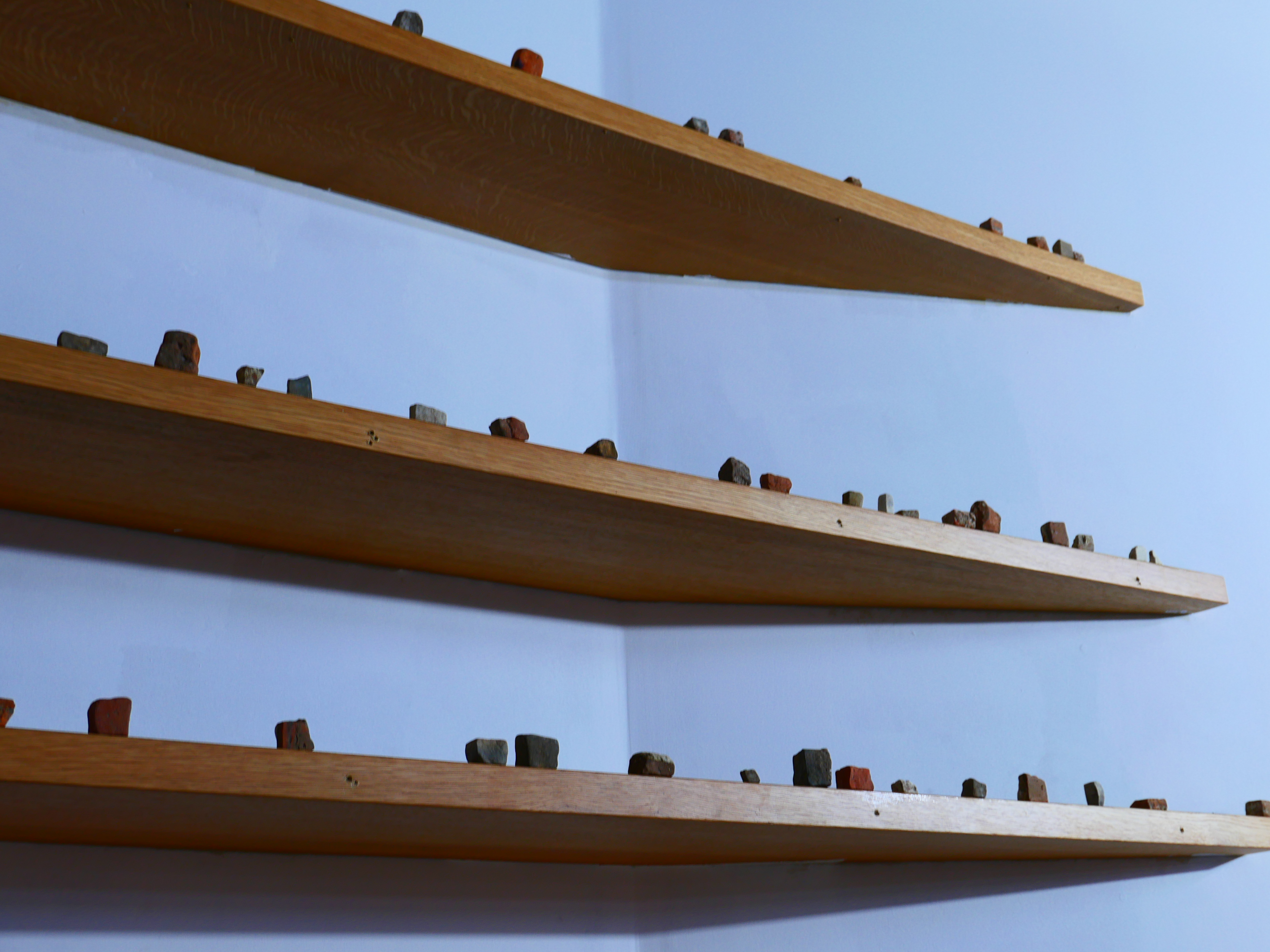
On shelves, behind what was once a café servery, a rhythm of stones sit like punctuation from an unlived sentence. These objects have been extracted from water and history, plucked by Mark Sowden from the Thames foreshow where they had sat for centuries. Before that, they had been artfully arranged as the mosaic floors of Roman villas, but as time changes so does meaning and existence. Sowden has not just placed them in the space, but also his studio, piling and arranging them for photographs set against a gridded backdrop, in a vain attempt to categorise the unknowable, cataloguing individual jigsaw pieces from an un-remakeable arrangement.
Sam Hodge also catalogues. Their hanging prints are made from unfolded found packaging, the kind of capitalist detritus that has increased with the boom of daily delivery. But here, using inks made from materials found on the foreshore such as coal, brick, and earth, Hodge has created ghosts from the cardboard, compressing them into layers. The result is an archive of the abandoned, found.


Perec was a member of his own collective, of sorts. The Oulipo group were interested in the potential of literature, with others including Raymond Queneau and Italo Calvino looking at formal and structural constraints to literature, imposing constraints or rules upon the process of writing in order to see what emerges though the processional layers. Another bunch of creatives and theorists of the time, the Situationists International, were similarly interested in testing how systems and instruction might interfere with a normative way of reading and making urban life.
The SI went deeper. Linguistically, they were interested in piercing what is visual and surface to uncover meaning and understanding from the complexity of what may be uncovered. Physically, they too went deeper – deconstructing the idea of the city at the same time as student protestors were busy deconstructing the actual city, the slogan Sous les paves, la plage! – roughly translating as Beneath the cobbles, the beach – became a slogan for both the political and cultural movements.
While their beach may have been figurative (though the layers of sand into which the city’s cobbles, ripped out as tool of political protest, might have gestured towards such a landscape) there is a truth in the idea that by scraping away the layers of architecture, order, governance, capital, and so on, another place is revealed, one more connected to pure landscape and existence. It is often riparian. And, so it is that under Bank Junction, the most ordered, monolithic, managed, surveilled, structured, capitalised, rhythmic, and solid bit of the city, not just now but through London and into Londinium’s history, there is a river.


The Walbrook still flows, unnoticed by city-workers above and unnoticed by any Oulipo writer who may be hanging at any open or former café at street level. Artist, however, can go deeper. Matthew Swift did just that with Situationist intent on a walking tour, helping strangers read the river beneath the street despite the years of debris that had piled over since it last saw the sky. Laying on the pavement listening to the depths, reading street names and language of the area, then descending to the more celebrated Thames to see where two become one.
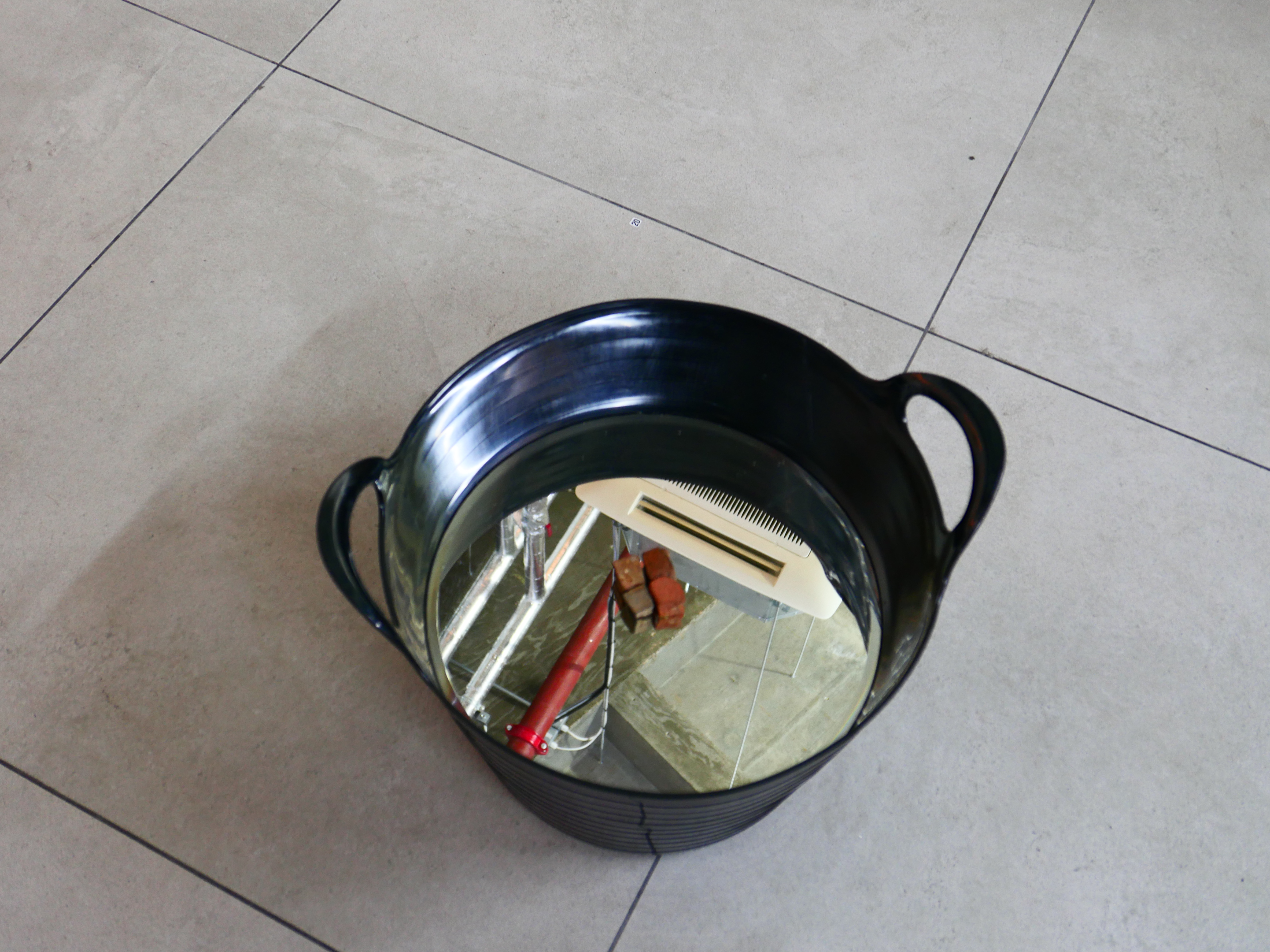
In the Ground Collective show, he translates that into pipework poetry. Re-reading cut-off pipework within what was once the café storeroom, Swift has created a new imaginary infrastructure for listening to the depths, a pathway from the past to the present, ceramic horns capping off utilitarian plumbing, reminding perhaps that all water is from one river, that which once was piped into the Poultry café was also once in the pre-Londinium Walbrook, and has travelled the world.


So above, so below. Looking up to look down, the collective have filled the space with abandon, not only filling backrooms, walls, and niches, but forcing the eyes upwards to see in a new way. A cluster of Sowden’s tesserae have somehow found themselves upon the concrete ceiling, furthering their unexpected journey from depths to heights, travelling upwards the same distance as Roman floor level is downwards. Also, Marcia Teusink has unrolled a scroll, flowing overhead carrying compressed stories and histories. Upon Japanese Shoji paper, various symbols and structures related to the Walbrook have been printed: from bacterial to animalistic to data level. To Teusink, the river is a document of pollution, the work is an attempt to extract strata of anthropogenic meaning from a shifting territory.
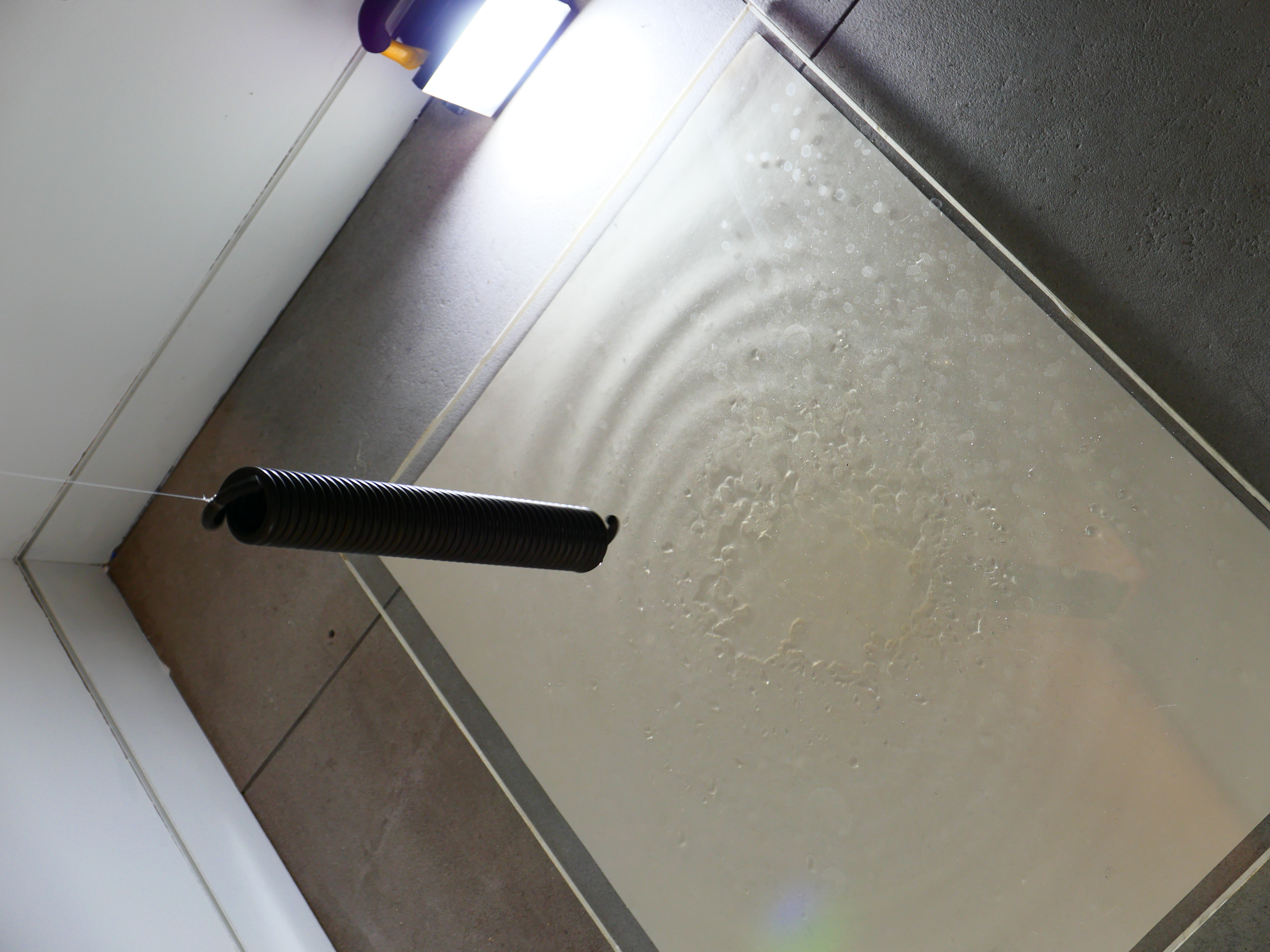
Madi Acharya-Baskerville has foraged the Thames foreshore to rescue detritus of other times and places. Using beads and textiles, connecting to the artist’s South Asian heritage, new conjoined characters are created. A curtain of hagstones, brick, ceramic, and shells hang like some object of ancient civilisational worship, but the items are all of this place, found when the Thames drops then transformed. A buoy hangs, transformed by found objects, hanging. Further along the gallery niches, another hanging item, Jim Roseveare’s metal coil relentlessly swings as if dowsing for the long-hidden River Walbrook underneath the City.
If nobody can step into the same river twice, then no water can flow through the same place twice. So the group of artists go wider to find the meaning and stories of the Walbrook, even when it ends up on different beaches and mingles with new stories. Joost Gerritsen’s video When the Rain Ceases – a collaboration with musician Heidi Erbrich – picks up the story of the water long after it has been in London or Londinium. He finds it in his local Spanish river, rapidly drying up and disappearing. In this removal, he asks what is revealed from the riverbed, what contamination looks like, and how nature can slowly dissipate under pressure.


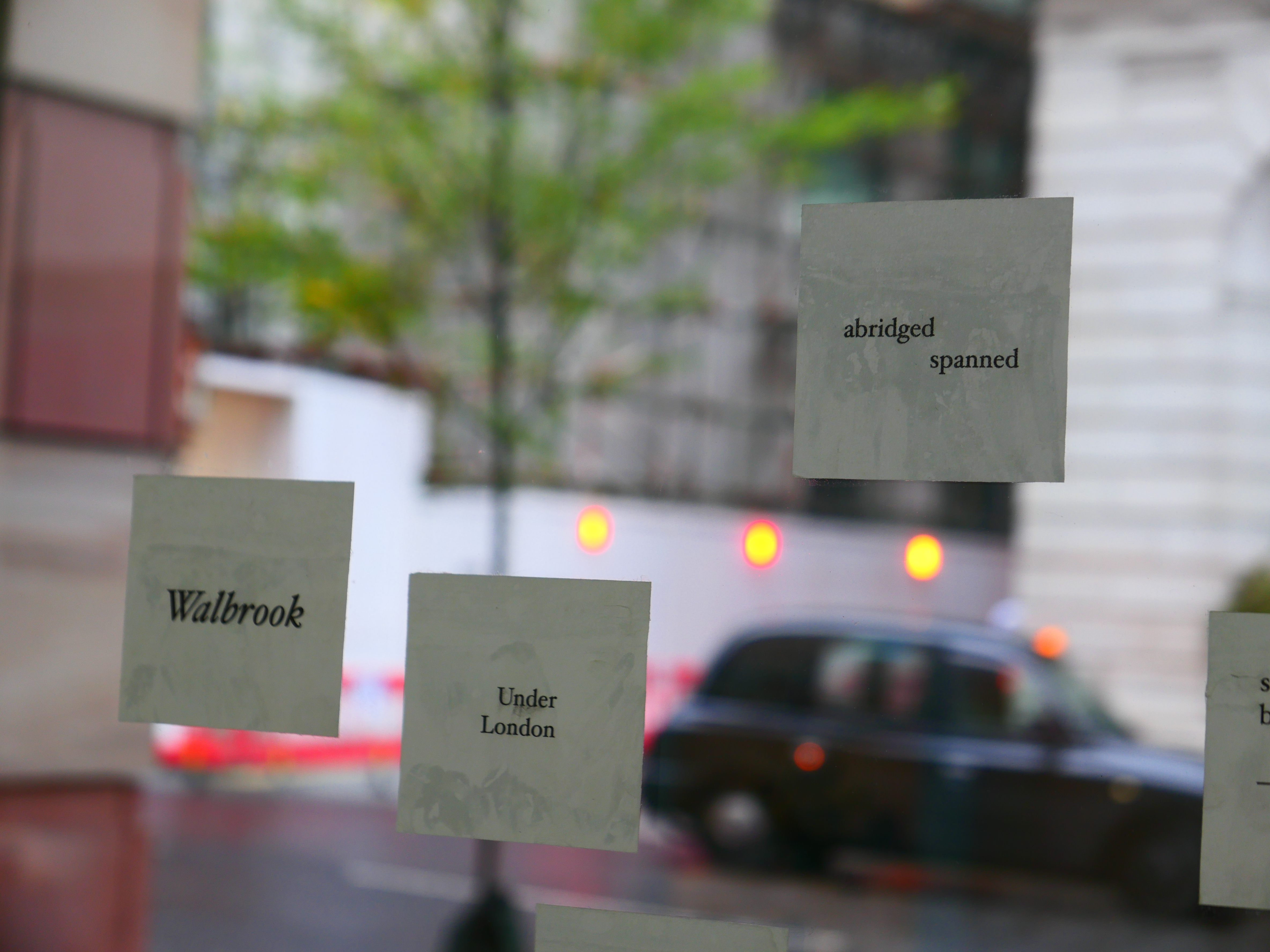
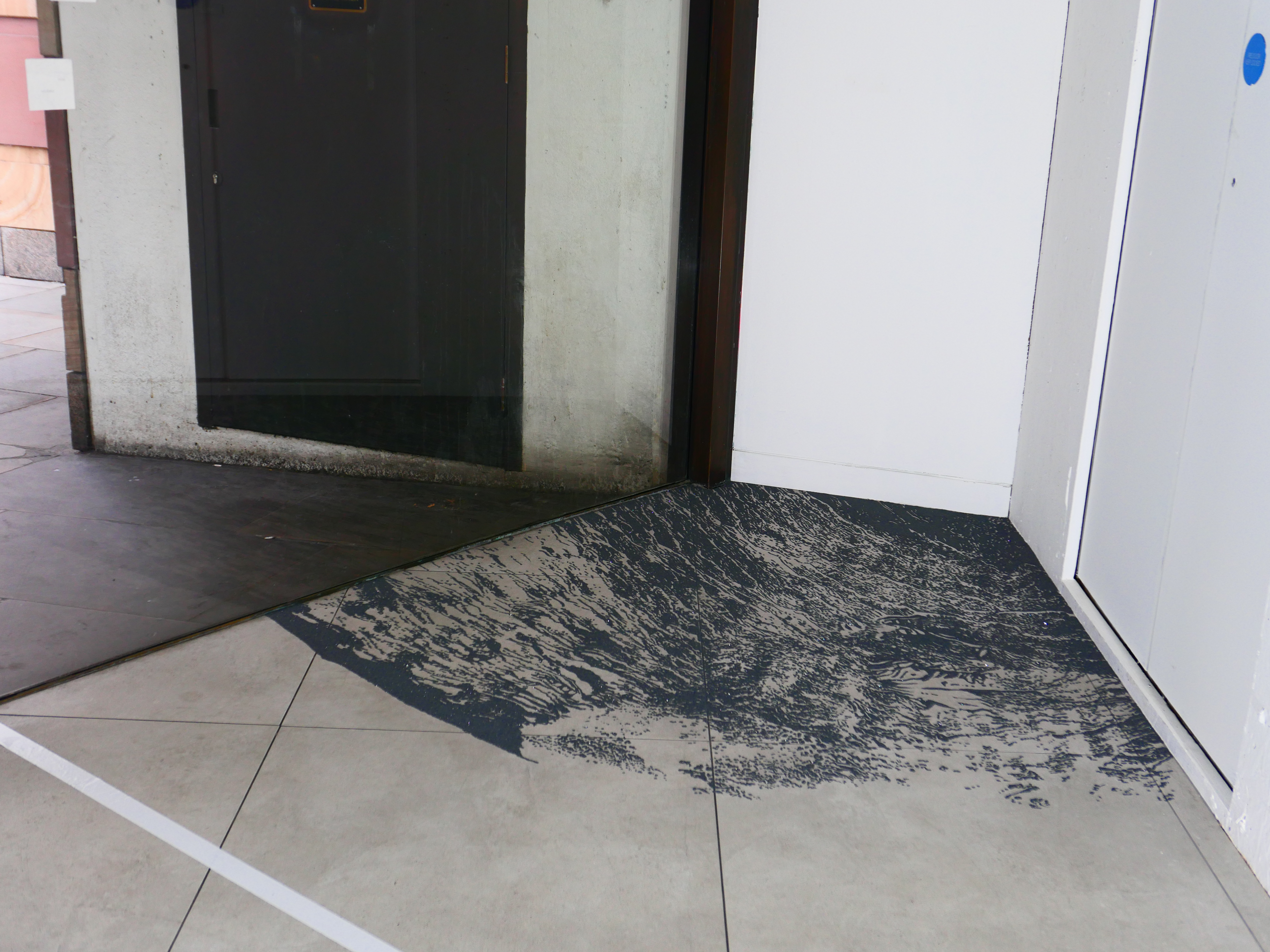
Tracy Hill (who we wrote about when exhibiting in
Manchester, see 00143) joined the collective as a guest, creating a
site-responsive delicate installation formed of carborundum. As if it had blown
into a corner, leaving its pattern of process, there is a seemingly natural
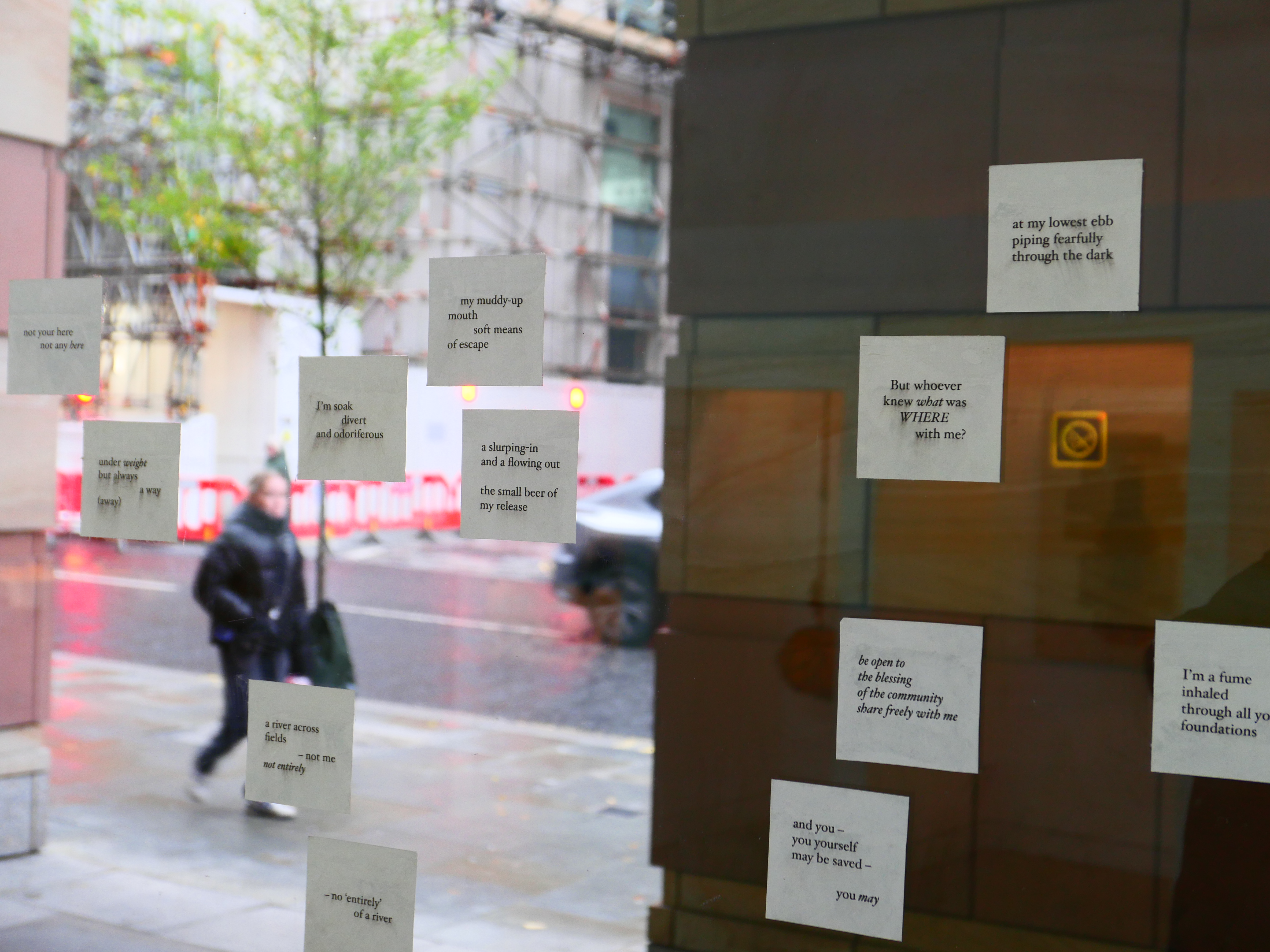
rhythm present, just as there similarly is in a window-mounted poem by Mike
Sims.
The streets outside No.1 Poultry were walked by T.S. Eliot in 1920 as he
started writing The Waste Land, his Lloyds office just around the corner. Just
as Eliot foraged the city for scraps of overheard conversation and minute character
observations, so too Sims finds words from the streets. Arranging poetic
details in a scattered approach, like a river finding its path over terrain the
reader can find their own stream from start to end.
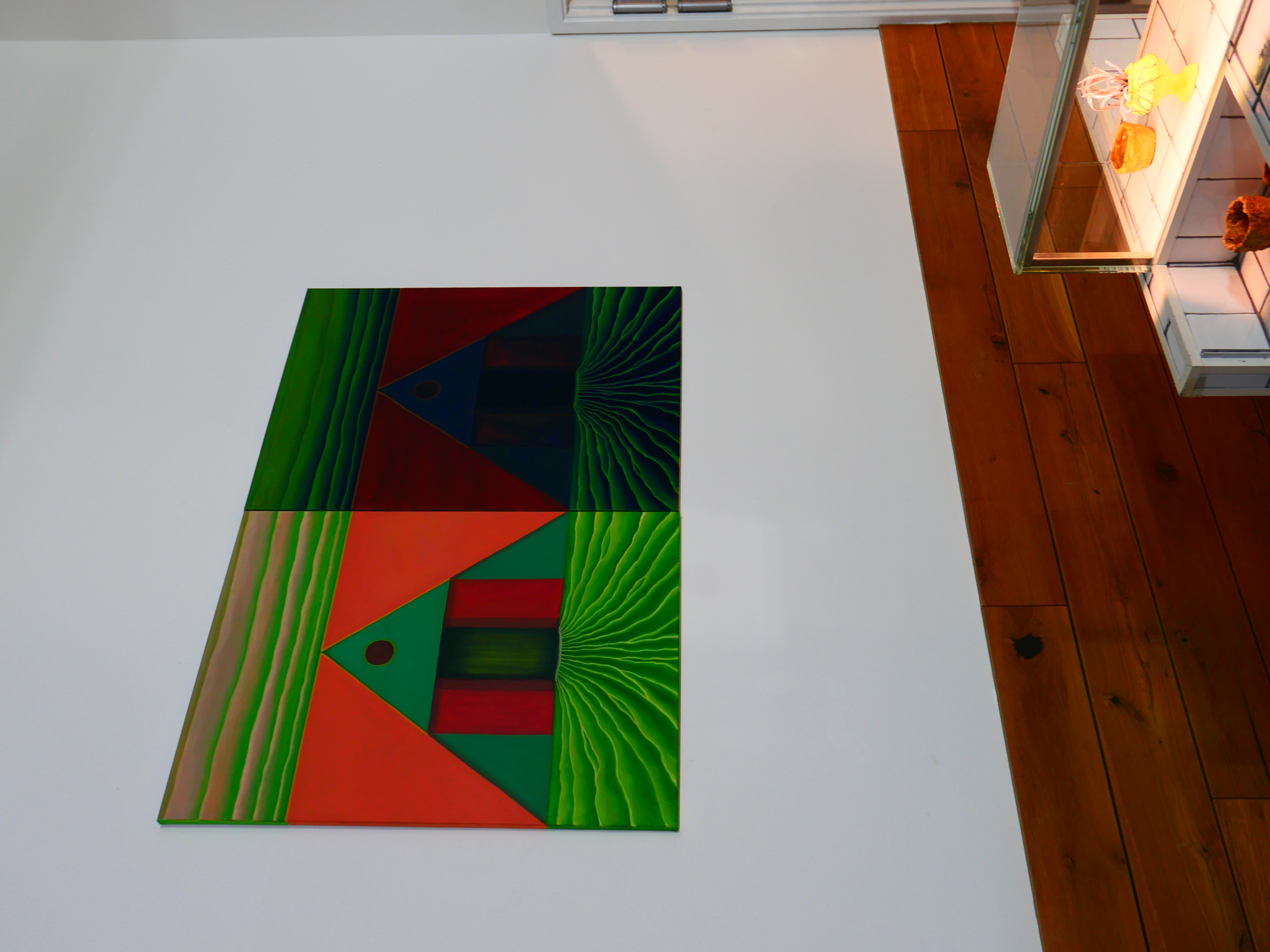
Having not left the gallery, yet somehow journeyed across places and times, heights and depths, Tom Banks pulls it all abruptly back to the current place. His geometric oil painting carries the angular pomo of the No.1 Poultry building this is all contained within. After following the path of the Walbrook with Mark Sowden, Banks’ Where Water Meets With Other Water documents both the manmade construct and the riparian flow as an imaginary gateway referencing where the Walbrook meets the Thames, here akin to a sci-fi portal.
If Perec rigorously documented the daily flow and observed city, and the Situationists added poetry and performance to scrape back some of the layers, here through foraging, finding, listening, and playing, Ground Collective have used other artistic methods to reveal what sits beyond the immediate. These works, and the methods used to examine the invisible, buried, ancient, and other, all also offer portal possibilities, ones anybody can enter should they want to go deeper.
This article is part of a series coinciding with the Hypha Studios x recessed.space gallery at No. 1 Poultry running for 12 months. For each of the eight exhibitions, a piece of new writing will be published in recessed.space to expand or reflect on the installation. More information about the recessed.space gallery can be found HERE.
Ground Collective is a group of eight multi-disciplinary artists, one poet, and rotating
guest contributors whose practices respond to found objects and everyday encounters in rural and urban
settings. Based in London, Sussex, Lancashire, and Spain, they have exhibited in various formations in
nonprofit spaces across London, Kent, and Sussex.
Hypha Studios is a charity matching creatives with empty spaces & regenerating the high street with cultural hubs & events for local communities. Founded by Camilla Cole in 2021, a fellow Director is Will Jennings who as well as teaching architecture & writing internationally on both art & architecture, is also the founder and editor of cultural platform recessed.space.
Hypha Studios operates a considered matchmaking process for each property & artist they work with, selecting the best creative projects for the space, whether large or small, short or long term. They are proud to have supported the cultural sector with over £2.7m worth of free space at a time gallery closures & funding cuts to the arts. Supporting the cultural ecosystem in towns & cities across Britain, they don’t only benefit the lives & careers of the selected artists, but also help engage local communities & support experiences with the arts in unexpected places.
Hypha Studios are soon launching Hypha Curates, an online platform where emerging artists can sell their work directly to new audiences & a public who may not already collect or understand the gallery system. When purchasing a work, buyers will know they are directly supporting the cultural sector, with 70% going to the artist to support their practice & 30% going to Hypha Studios to support their charitable work across Britain.
www.hyphastudios.com
www.hyphacurates.com
Will Jennings is a London based writer, visual artist & educator interested in cities, architecture & culture. He has written for Wallpaper*, Canvas, The Architect’s Newspaper, RIBA Journal, Icon, Art Monthly & more. He teaches history & theory at UCL Bartlett & is director of UK cultural charity Hypha Studios.
www.willjennings.info
guest contributors whose practices respond to found objects and everyday encounters in rural and urban settings. Based in London, Sussex, Lancashire, and Spain, they have exhibited in various formations in nonprofit spaces across London, Kent, and Sussex.
Hypha Studios is a charity matching creatives with empty spaces & regenerating the high street with cultural hubs & events for local communities. Founded by Camilla Cole in 2021, a fellow Director is Will Jennings who as well as teaching architecture & writing internationally on both art & architecture, is also the founder and editor of cultural platform recessed.space.
Hypha Studios operates a considered matchmaking process for each property & artist they work with, selecting the best creative projects for the space, whether large or small, short or long term. They are proud to have supported the cultural sector with over £2.7m worth of free space at a time gallery closures & funding cuts to the arts. Supporting the cultural ecosystem in towns & cities across Britain, they don’t only benefit the lives & careers of the selected artists, but also help engage local communities & support experiences with the arts in unexpected places.
Hypha Studios are soon launching Hypha Curates, an online platform where emerging artists can sell their work directly to new audiences & a public who may not already collect or understand the gallery system. When purchasing a work, buyers will know they are directly supporting the cultural sector, with 70% going to the artist to support their practice & 30% going to Hypha Studios to support their charitable work across Britain.
www.hyphastudios.com
www.hyphacurates.com
Will Jennings is a London based writer, visual artist & educator interested in cities, architecture & culture. He has written for Wallpaper*, Canvas, The Architect’s Newspaper, RIBA Journal, Icon, Art Monthly & more. He teaches history & theory at UCL Bartlett & is director of UK cultural charity Hypha Studios.
www.willjennings.info
visit
Ground Collective: Messages from a Silent River continues at the Hypha Studios x recessed.space gallery at No.1 Poultry in the City of London until 6 December.
Further details available from: www.hyphastudios.com/marcia-teusink
images
All photographs © Will Jennings.
Imagery supported by MPB - the right way to buy, trade and sell camera gear. More information on MPB can be found here.
publication date
02 December 2025
tags
xxx
Further details available from: www.hyphastudios.com/marcia-teusink
